Engineering · research · releases
Blog
Release notes, methodology dives, and benchmarking deep-dives. New posts land alongside major releases and research findings.
2026·10·21
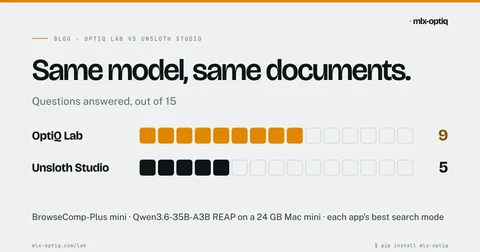
OptiQ Lab beat Unsloth Studio on hard research questions
Same local model, same server, same 1,349 documents: OptiQ Lab answered 9 of 15 BrowseComp-Plus mini questions and Unsloth Studio 5. How we set up a fair test.
product
2026·10·15
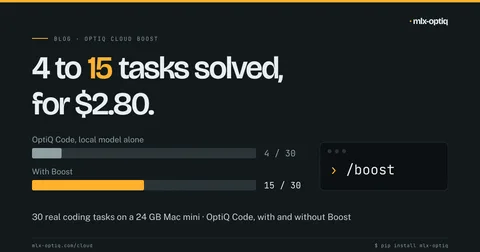
Boost in OptiQ Code: 4 to 15 of 30 coding tasks for $2.80
A local model on a 24 GB Mac mini solved 4 of 30 coding tasks. With Boost it solved 15, and hidden tests passing rose from 41% to 92%, for $2.80.
product
2026·10·11
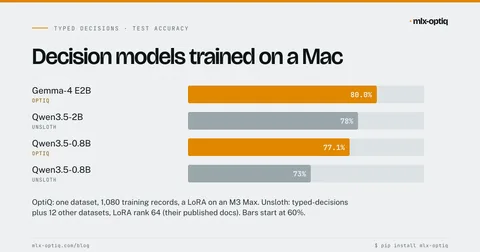
Training decision models on a Mac
A LoRA and a new schema head on Gemma-4 E2B reach 0.802 on Typed Decisions, from the benchmark's 1,080 training records on an M3 Max. Compared with Unsloth's published numbers.
engineering
2026·08·18
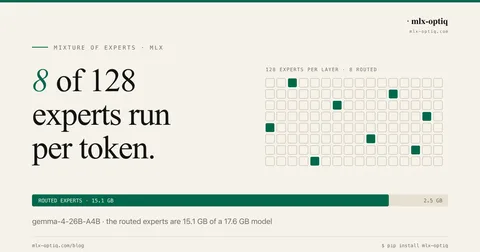
Quantizing a mixture-of-experts model on MLX
On gemma-4-26B-A4B the routed experts are 15.1 GB of a 17.6 GB model, fused 128 to a tensor. How sensitivity is measured on that, a flag that silently did nothing on every Gemma-4, and a prefetch that cost 8% of decode throughput.
engineering
2026·08·07
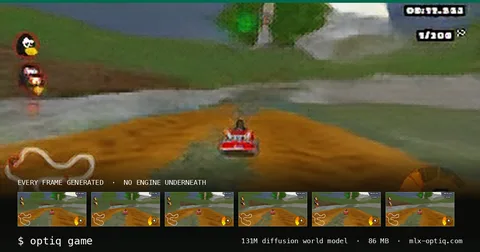
A world model you can drive, hidden in mlx-optiq
optiq game pulls 86 MB and opens a kart racer with no track, no physics and no renderer. A 131M diffusion model paints every frame from the last seven and the keys you are holding, at about seven frames a second on MLX.
engineering
2026·08·03
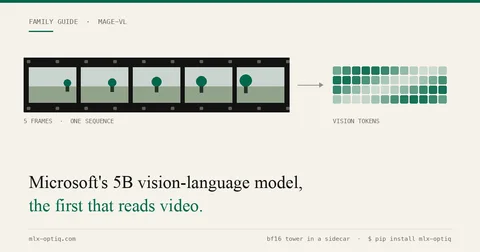
Mage-VL: our first video model, running on a Mac
Microsoft's 5B vision-language model reads images and video. Quantized by OptiQ, it runs on a Mac in 3.7 GB with no PyTorch. The language tower goes to mixed 4/8-bit; the vision tower stays bf16 in a sidecar.
Release
2026·07·25
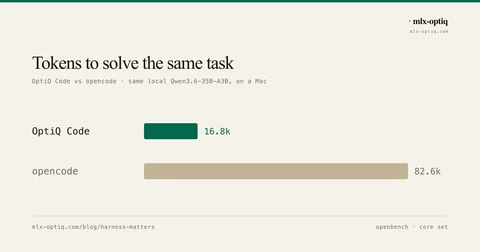
OptiQ Code vs opencode: a local coding-agent benchmark
The same local model driven by two coding agents through one open benchmark. OptiQ Code and opencode solve the same openbench tasks, but OptiQ Code moves about 5x fewer tokens.
Benchmark
2026·07·16
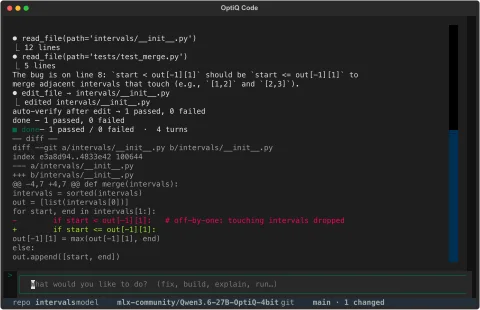
The best coding agent for local models on a Mac
OptiQ Code is a terminal coding agent that drives whatever
optiq serve is serving, offline, on your Mac. Engineered for weak local models: never an empty patch, edit-apply resilience, a stall-proof loop. 36% of a SWE-bench-Lite subset with a 4B with a valid patch on every task.Product

2026·07·10
A 122B model, two Macs, and a flight simulator
Qwen3.5-122B-A10B ships as 244 GB of bf16 weights. A 2-bit quant of it (42.8 GiB) now runs fully resident across a 36 GB M3 Max and a 24 GB M4 over Thunderbolt, at 20.5 tok/s, from one
optiq cluster serve. Here it writes a flight simulator and flies it in the browser. Plus the memory rules that decide whether a ring runs at 20 tok/s or 0.1, and the four wrong explanations we chased to find them.Engineering
2026·06·20
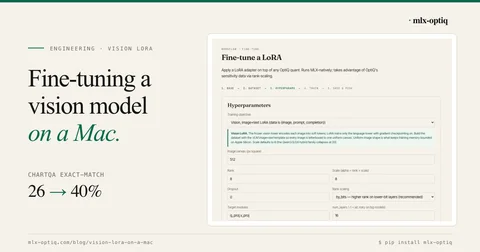
Fine-tuning a vision model on a Mac
OptiQ now fine-tunes the language tower of a quantized VLM on image+text data, locally on a 24 GB Mac. A LoRA on
Qwen3.5-0.8B-OptiQ-4bit lifts ChartQA exact-match from 26 to 40%. The two walls we hit (memory ratcheting on variable image sizes, and mode collapse on short targets) and the fixes (uniform letterbox + gradient checkpointing, gradient clipping + lower LR), plus a Lab dataset template and Fine-tune wizard for the whole flow.engineering
2026·06·19
A 122-billion-parameter model, on a laptop
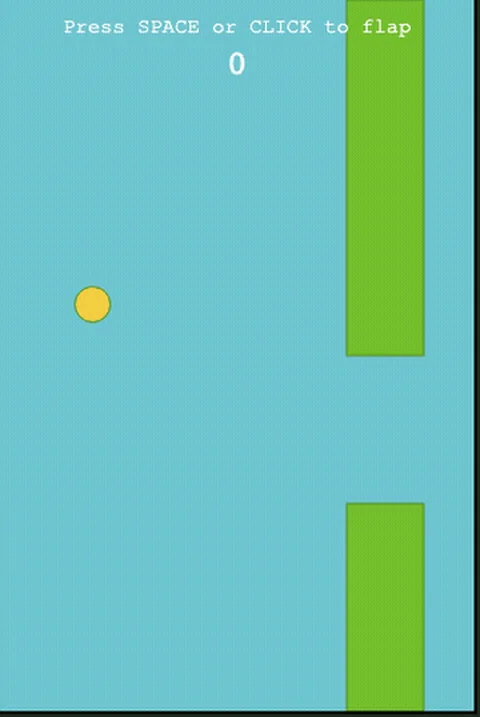
mlx-optiq 0.2.5 runs Qwen3.5-122B-A10B on a 36 GB Mac by streaming its mixture-of-experts off SSD: 12 GB stays resident, the other 35 GB is read one expert at a time. The quant is a 2-bit
static allocation (44 GB on disk), the new no-measurement method that assigns bits by architecture and matches the calibration method on small models at 125× the convert speed. The model wrote a working Flappy Bird and ran it.release
2026·06·06
mlx-optiq can see: image + text on Gemma-4 and Qwen3.5/3.6
Image+text on the Gemma-4 and Qwen3.5/3.6 families. One bf16 vision sidecar makes the same published repo load text-only under stock
mlx-lm and full image+text under OptiQ, with no separate vision build and no mlx-vlm runtime dependency. Three vision architectures (SigLIP, the encoder-free Gemma-4 12B unified, and the Qwen3-VL tower) vendored and reproduced bit-exact (max|Δ|=0.0). Upload a picture in the Lab, or send an image_url to optiq serve: counting, shapes, colors, OCR, charts, and spatial questions all answer correctly.release
2026·06·01
A 1B humanizer that matches human writing on an AI detector
Stacked SFT + DPO LoRAs on
MiniCPM5-1B-OptiQ-4bit close 100% of the gap to human writing on the RADAR AI detector. P(AI) drops from 0.51 (source) to 0.37, exactly matching the human reference. The recipe uses OptiQ 0.1.4's --mount-adapter for textbook DPO continuation and per-request adapter stacking at serve time. Two 120 MB adapters on a 875 MB base, all local on a 24 GB Mac.engineering
2026·05·22
Gemma-4 spec decoding on Apple Silicon
First MLX port of Google's Gemma-4
-assistant drafter. 1.18x decode geomean across five prompt categories on E4B with the 4-bit OptiQ quant, 31% acceptance, γ=1 greedy. Two RMSNorm-shaped formula bugs that took us from 0% to 33% acceptance, plus the bf16 multi-token verify artifact we cannot route around. Wired into OptiQ Lab Server as "Spec drafter".research
2026·05·21
Tools in OptiQ Lab chat: local web search, sandboxed Python, and a terminal
v0.1.0 ships three tools the model can call locally: DuckDuckGo search, Python in an AST-checked sandbox, and a bash terminal in the same sandbox with token-aware command blocking. Healer for six malformed tool-call shapes. 25-turn budget with duplicate-call de-dup and a budget-exhausted re-prompt. Stop button that SIGKILLs the running subprocess. Matplotlib output renders inline.
release
2026·05·21
When 4-bit KV cache uses more memory than fp16, and how OptiQ fixes it
Stock mlx-lm 4-bit KV cache on a 24 GB Mac at 32k context actually peaks higher than fp16 (16.35 GB vs 11.51 GB). OptiQ's streaming converter and FlashAttention-2 N-tiling drops u4 peak to 7.60 GB, 34% below fp16. At ±2% fp16 speed parity. Mixed-precision KV scores 33% better than uniform 4-bit at the hash-hop hops=3 differentiation point.
research
2026·05·19
Getting MTP to actually work on Apple Silicon
Wiring Multi-Token Prediction speculative decoding into OptiQ took three fixes: a duplicated model load, a wrong probabilistic verify, and untruncated sampling distributions. We landed at 1.20x / 1.32x / 1.40x on Qwen 4B / 9B / 27B with greedy decoding on a 24 GB M4 Mac, within 5 percent of unsloth's 1.4x on the same model class on an RTX 6000. Plus the math for why depth 2 does not help on Metal.
research
2026·04·28
The mlx-optiq eval framework: six benchmarks, one Capability Score
GSM8K-50 alone misses tool-calling and long-context regressions. The two-stage eval (KL + GSM8K-50 for triage, MMLU + GSM8K + IFEval + BFCL + HumanEval + HashHop for headlines) drives every quant we ship. Plus the auto-resolved KL reference, sandboxed code execution, and a single Capability Score that's the unweighted mean of all six.
methodology
2026·04·28
optiq.jsonl: a six-domain calibration mix for mixed-precision quantization
WikiText-2 measures prose; modern LLMs do prose, reasoning, code, agent loops, tool-calling, and constraint-following instructions. We replaced the calibration set with 40 hand-curated samples across all six domains, bundled inside the package, fully reproducible. Calibration data decides what a quant protects.
engineering
2026·04·25
Gemma-4 lands on mlx-optiq: four sizes, +32 pp on the small one
Adding Google's full Gemma-4 instruct lineup: e2b, e4b, 26B-A4B sparse MoE, and 31B dense. The +32-point GSM8K recovery on gemma-4-e4b is the cleanest mixed-precision win we have. Plus the shared-KV caveat that means you'll want Qwen for quantized-KV serving.
engineering
2026·04·17
TurboQuant: postmortem on a research path we didn't ship
We built rotated-space KV attention with a custom Metal kernel. The benchmarks looked good: 100 % needle retrieval at 4-bit vs 73 % for affine. We still chose affine for the shipping path. Plain writeup of the technique, the numbers, and why the marginal win didn't justify a parallel serving stack.
postmortem
2026·04·08
Sensitivity-aware LoRA: fine-tuning that respects the bit budget
The same per-layer signal that drives mixed-precision quantization also drives adapter rank. 8-bit-quantized layers get 2× the adapter rank of 4-bit-quantized ones at the same parameter budget. Validation loss drops 12 % in head-to-head A/Bs. Plus the empirical training-ceiling map for a 36 GB Mac across all 10 supported models.
engineering
2026·03·20
Not All Layers Are Equal: mixed-precision quantization for weights and KV cache on Apple Silicon
The research foundation behind mlx-optiq. Some layers are 56× more sensitive than others. The KV cache becomes the dominant memory cost at long contexts. Mixed-precision recovers what uniform 4-bit drops; mixed-precision KV fixes the perplexity collapse uniform 4-bit causes.
research